
Lincoln SEN Transport Communication: Handover Planning
In short
How authorised carers, schools, our office, drivers and any assigned PA can keep Lincoln SEN transport communication consistent — covering handovers, routine…
Lincoln SEN transport communication works best when everyone involved — the authorised carer, the school, our booking office, the driver and any assigned passenger assistant (PA) — agrees in advance who tells whom about a change, and how that message gets confirmed. This guide sets out a practical handover routine for pre-booked SEN journeys to and from Lincoln, rather than leaving it to guesswork on the morning itself.
I run Phoenix Travel Contract Hire Ltd, based in Gainsborough, Lincolnshire, holding West Lindsey District Council private hire operator licence PO2602. We provide pre-booked, fixed-price journeys with licensed, enhanced DBS-checked drivers, including school and SEN transport to and from Lincoln, Gainsborough, Scunthorpe, Market Rasen, Retford, Worksop, Kirton in Lindsey and the villages between, using core roads such as the A156, A159, A631, A15 and A46. A good proportion of the SEN journeys we carry out depend less on the vehicle itself and more on whether the right people knew about a change before the driver set off — which is the focus of this guide.
Lincoln SEN Transport Communication: Why Handover Planning Matters
A standard school run usually involves two parties: a parent and a driver. SEN transport routinely involves more — a parent or authorised carer, the school's transport contact, sometimes the council's transport team where a journey is funded through an Education, Health and Care Plan (EHCP), our own booking office, the driver, and a passenger assistant (PA) where one is contracted for the route. Each handover between these people is a point where information can either travel cleanly or get lost. Planning that handover properly, before a placement starts, is what keeps routine days routine and makes genuine changes easy to spot and act on.
This isn't about medical information or care needs, which sit with the school, the family and, where relevant, the local authority. It's about the practical, day-to-day logistics: who is collecting, from where, at what time, and who confirms it when something moves.
Who Needs to Be in the Loop
Before a journey starts running regularly, it's worth agreeing exactly who holds each piece of the communication chain:
- The authorised carer or parent — the only person who can confirm a change to pickup address, collecting adult, or cancellation for that day
- The school's transport contact — usually the office or a named coordinator, who tells families about early finishes, inset days or closures
- The council transport team, where the place is arranged under an EHCP or similar funding route — they handle eligibility, reviews and any change of provider
- Our booking office — the point of contact for confirming, amending or cancelling a specific journey
- The driver — carries out the booked journey as confirmed, rather than fielding last-minute scheduling decisions from the roadside
- A passenger assistant (PA), where one is assigned to a particular contract — handles the handover at the vehicle door, but isn't a substitute for the carer confirming changes with the office in advance
Setting this list out once, at the start of a placement, avoids the common problem of a message being passed to the wrong link in the chain — a change mentioned to the driver on the day, for example, which never reaches the office or the school.
Setting Up the Handover at the Start of a Placement
When a new SEN journey is first booked, it's worth agreeing a few things in writing before the first pickup:
- A single named contact at the home end, with a phone number the office can reach on the morning of travel if needed
- The school's own designated transport contact, separate from general school reception where possible
- Whether a PA is assigned to the contract, and how that PA communicates day-to-day handover details with the carer — without this being treated as a guarantee of the same PA or vehicle on every single journey, since cover arrangements can change
- What counts as routine (the same pickup, same address, same school day) versus something that needs fresh confirmation (a different address, a different collecting adult, an unusual finish time)
That last point is the one that causes most confusion in practice. A family might assume a one-off change has been understood by everyone, when in fact only the school knew, or only the driver was told verbally on the day.
Agreeing Routine Changes Without Confusion
Most SEN transport problems aren't dramatic — they're small timing or address changes that didn't reach the right person. A workable approach treats any change as needing two things: a clear statement of what's changing, and written confirmation back from the office that it's been received and applied to the booking.
Pickup time shifts by a few minutes
- Who to notify first
- Office, not the driver directly
- Typical notice needed
- As much notice as possible, ideally the day before
Different authorised adult collecting
- Who to notify first
- School and office, confirmed in writing
- Typical notice needed
- Before the journey, not verbally on the day
Temporary change of address
- Who to notify first
- Office, confirmed by school or carer
- Typical notice needed
- Clear written notice ahead of the journey
School closed or inset day
- Who to notify first
- School informs carer; carer confirms cancellation with office
- Typical notice needed
- As soon as the date is known
Change of school or end of placement
- Who to notify first
- Council transport team and office
- Typical notice needed
- Several days ahead, following the council's own process
| Situation | Who to notify first | Typical notice needed |
|---|---|---|
| Pickup time shifts by a few minutes | Office, not the driver directly | As much notice as possible, ideally the day before |
| Different authorised adult collecting | School and office, confirmed in writing | Before the journey, not verbally on the day |
| Temporary change of address | Office, confirmed by school or carer | Clear written notice ahead of the journey |
| School closed or inset day | School informs carer; carer confirms cancellation with office | As soon as the date is known |
| Change of school or end of placement | Council transport team and office | Several days ahead, following the council's own process |
The general principle behind that last row — how eligibility, applications and annual reviews for children with SEND transport are handled — sits with Lincolnshire County Council rather than with any transport provider. Their published guidance on transport for children with special educational needs and disability sets out how eligibility is assessed and how families apply or request a review, which is the authoritative source for anything beyond the day-to-day logistics covered here.
What Happens on the Day: Driver, Office and PA Roles
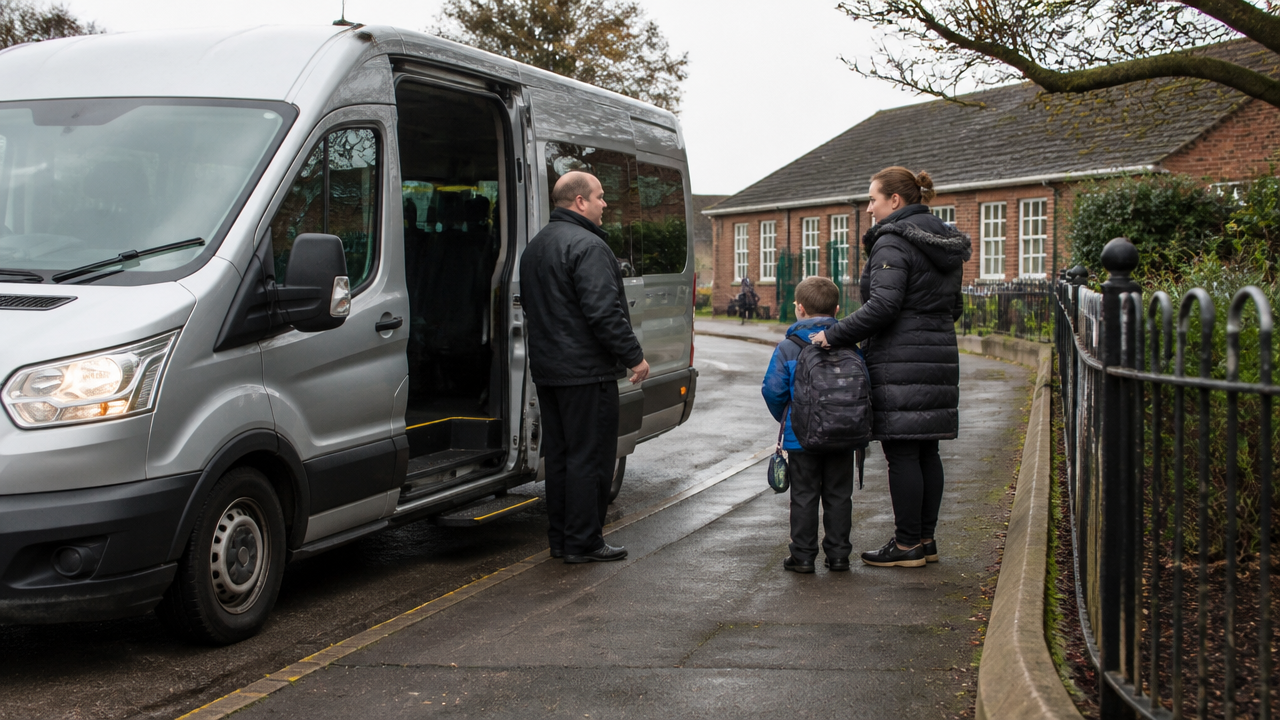
On the morning of a journey, roles are worth keeping distinct. The driver's focus is the safe, on-time completion of the booked journey — not managing phone calls about schedule changes while driving. The office is the point of contact for anything that needs deciding or confirming, including a late running journey, a locked door, or a carer who hasn't appeared at the agreed collection point. Where a PA is assigned to the route, their role at handover is typically to manage the brief, practical exchange at the vehicle — confirming who's travelling and that the handover has happened — rather than taking on scheduling decisions that should go through the office first.
Keeping these roles separate means a single phone call in the morning, to one number, is usually enough to resolve most on-the-day queries, rather than several overlapping conversations with different people.
Routine Reviews and Planning Ahead
SEN transport arrangements aren't usually static for a full school year. Term dates change, EHCP reviews happen, and a child's needs or school placement can shift. Building in a regular check — at the start of each term, for instance — of whether the agreed contact details, collection address and authorised adults are still correct avoids a lot of avoidable confusion later in the year. This is a separate process from the booking itself, but it's the kind of groundwork that makes the booking run smoothly once it's in place.
For families newer to how council-contracted SEN journeys fit alongside privately arranged transport, our broader guide to school and SEN transport in Lincoln covers that distinction in more depth, and our guide to trusted school and SEN taxi transport in Lincolnshire sets out general planning considerations for parents arranging this kind of journey for the first time. If a journey is funded through an EHCP specifically, our separate piece on EHCP taxi transport is worth reading alongside this one. More general Lincoln and Lincolnshire travel planning is covered across our blog.
Who should I contact if my child's pickup time needs to change?
Contact our office directly rather than relying on a message passed through the school or the driver. Confirm the new time in writing and wait for confirmation that the booking has been updated, particularly if the change is permanent rather than a one-off.
What happens if the authorised adult collecting my child changes?
This needs confirming with both the school and our office before the journey, not verbally on the day. Drivers and any assigned PA work from the authorised details on file, so a change that hasn't been confirmed in advance can't be acted on at the roadside.
Will the same driver and PA be assigned every day?
We can't guarantee a specific driver or PA for every journey, since cover arrangements, absence and scheduling can mean a different licensed, DBS-checked driver or assigned PA covers a particular day. What stays consistent is the booking detail itself — address, time and authorised contacts — which is why keeping that information accurate matters more than who's behind the wheel on any given morning.
How much notice does the office need for a routine change?
As much as possible — ideally the day before for timing changes, and further ahead for anything involving a different address or collecting adult. Same-day changes can sometimes be accommodated but are harder to guarantee, particularly earlier in the morning before routes are finalised.
If you're setting up a new SEN transport arrangement to or from Lincoln, or reviewing how communication works on an existing one, call Phoenix Travel on 01427 802315 to talk through the booking and handover details before the first journey runs.
Topics in this guide
Related guides on the blog
All travel guides- Trusted School Transport Lincolnshire: Safe & Reliable JourneysSchool transport in Lincolnshire should mean enhanced DBS-checked drivers, fixed-price journeys and genuine experience with SEN pickups. Here's how Phoenix Travel sets up safe, dependable school and SEN transport across the district.
- Special Needs Taxi Transport: Safe SEN School Runs in LincolnshireSpecial needs taxi transport should mean one trusted driver, a fixed price, and a vehicle suited to your child's needs every single day. Here's how Phoenix Travel arranges licensed, DBS-checked SEN school transport across Gainsborough and West Lindsey.
- School and SEN Transport Lincoln: How Council-Contracted Journeys Actually WorkA plain-English guide to how home-to-school and SEN transport is arranged around Lincoln and Lincolnshire, who qualifies, how routes are set, and what families can do when they need something the council contract doesn't cover.
- SEN Transport in Lincolnshire: Safe, Licensed Private Hire for SchoolsLooking for reliable SEN transport in Lincolnshire? Phoenix Travel provides DBS-checked drivers, wheelchair accessible vehicles and fixed-price local authority contracts across Gainsborough and West Lindsey.